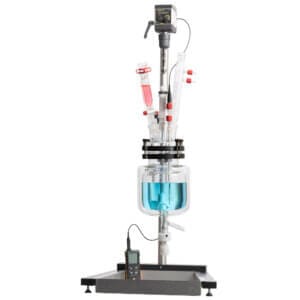
Laboratory reactors are systems for improving and reproducing chemical reaction, dispersion, homogenization and mixing processes on a laboratory scale. Thanks to their flexible design, they can be individually configured and thus optimally adapted to the respective field of application. Schmizo laboratory reactors are made of high-quality borosilicate glass.
They are available in single and double-walled versions as well as with an additional vacuum jacket and can be equipped with a bottom drain valve if required. In the pilot plant or kilo laboratory, our reactors are used in the following applications, for example:
A laboratory reactor is a scaled-down stirred tank reactor. It offers the same basic functions as a chemical reactor used for production purposes, but is mainly used in laboratories in the field of research and development.
Modern laboratory reactor systems are usually partially or fully automated to allow continuous monitoring and thus unattended overnight operation. They are usually installed in a fume hood to prevent the accumulation of explosive gas mixtures in the room air and to protect laboratory personnel from any toxic substances that may be released.
In contrast to production systems, glass reactors are preferred in the laboratory. The borosilicate glass used for this purpose is characterized by a low coefficient of thermal expansion and is therefore insensitive to sudden temperature fluctuations. Glass is also extremely resistant to acids, alkalis and high temperatures. At the same time, it offers a clear view of the processes taking place in the reactor at all times.


| DN | ID mm | AD mm |
| 60 | 68 | 98 |
| 100 | 105 | 137 |
| 120 | 120 | 150 |
| 150 | 150 | 184 |


| DN | ID mm | AD mm |
| 60 | 59 | 100 |
| 100 | 96 | 138 |
| 120 | 118 | 158 |
| 150 | 141 | 184 |
| 200 | 199 | 242 |
Tolerances by analogy to DURAN glass tubes.
DN = nominal width , ID = inner diameter, AD = outer diameter

| DN | ID mm | AD mm |
| 15 | 15 | 28.6 |
| 25 | 25 | 42.2 |
| 40 | 40 | 57.4 |
| 50 | 50 | 70 |

| KS | ID mm | AD mm |
| 19/9 | 9 | 19 |
| 29/15 | 15 | 29 |
Other sizes by request

| Type | ID mm | AD mm |
| GL14 | 9 | 12 |
| GL18 | 12.4 | 16 |
| GL25 | 18.4 | 15822 |
| SVL15 | 12.4 | 16 |
| SVL22 | 18.4 | 22 |
On request also available with hose connections (AD 6 – 12 mm). All other kinds of flanges or connection systems by request.
The most important reactor types for the laboratory include stirred, mini- and high-pressure reactors. Schmizo reactors are available as single-walled, double-walled, or triple-walled reaction vessels in various designs.
It is important to match the wall thickness of the reactor vessel to the expected operating pressure. However, you should not oversize, as thicker walls could make temperature control more difficult.
Like their large counterparts, laboratory reactors can:
Our range of accessories extends from thermometers and temperature probes to pH and redox electrodes, coolers, dropping funnels and ground joint plugs. In addition, you will find stable table racks, special holders and floor racks.